
Behind the Lens: Cappadocia Photography
What shapes the way we photograph Cappadocia? From our light philosophy and gear strategy to color grading, client experience, creative direction, and large group shoots — here, we open the curtain on every step behind the frame.

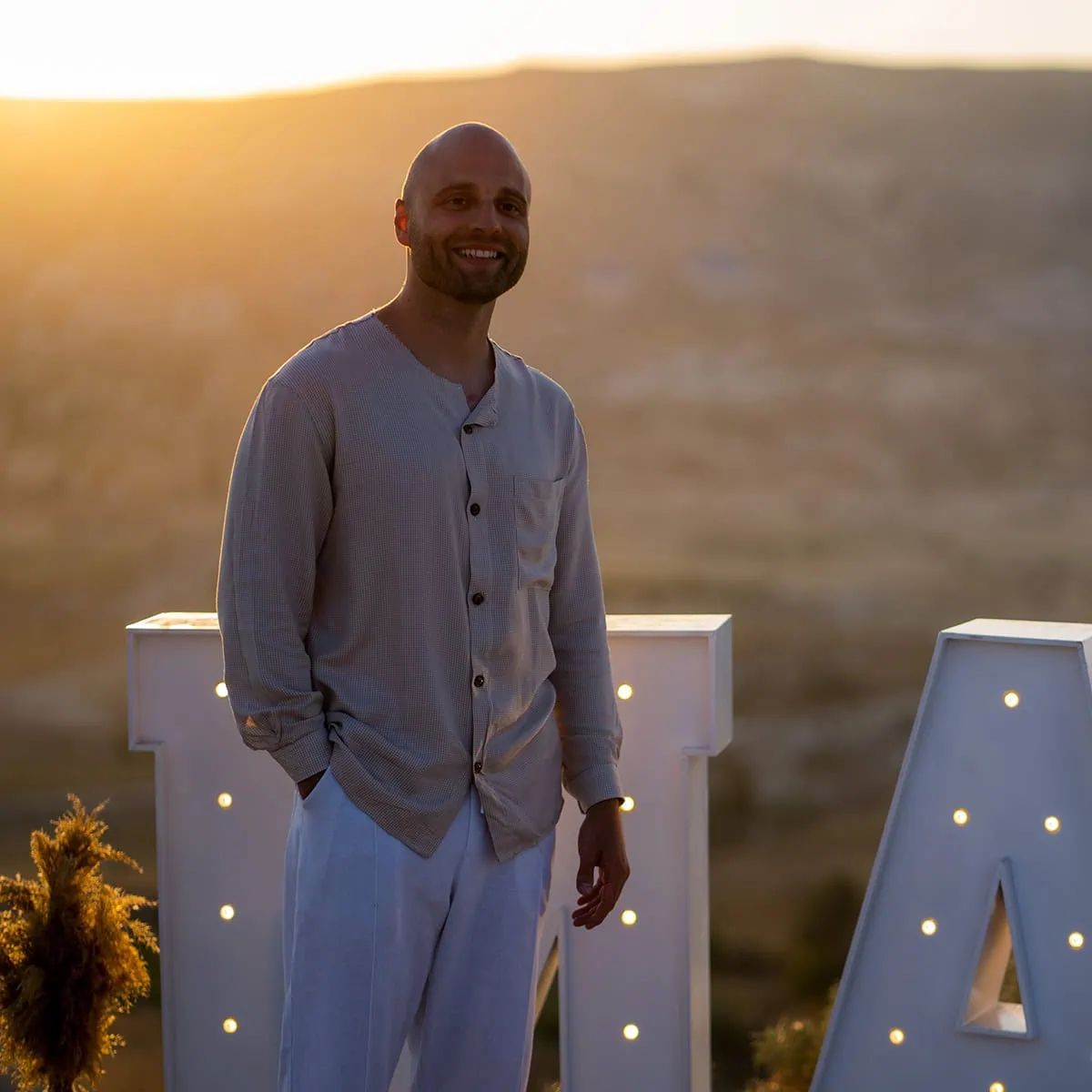
The camera bag is still closed. The alarm went off at 3:45 AM. By 4:15 we are loading gear, checking the weather forecast, and confirming the balloon flight status. We arrive at the location 45 minutes before sunrise to scout the exact light angle, set up any props, and brief the couple. This pre-dawn preparation is invisible to clients — but it is essential to every great image.
Cappadocia is asleep, but the sky has already begun its shift — moving through the deepest navy toward the thinnest trace of blue. A gentle mist rises from the valleys, fairy chimneys emerge as dark silhouettes. These minutes are where our photographs are born. Every frame in our portfolio is, in some way, a product of this hour.
We have been working in this landscape for eight years. More than 50,000 frames delivered. Every session different from the last, because Cappadocia never repeats the same light twice. In this piece, we open the curtain on how we work — our philosophy, our equipment, our color grading process, client experience, creative direction, large group shoots, and how we scout the locations that make our sessions distinct. If you have ever wondered what happens between the moment we arrive and the moment you receive your photographs, the answer is here.
Our Photography Philosophy
Photographing Cappadocia is not about recording a scene. The light here — especially during the transitions of golden and blue hour — constructs the narrative on its own. Our role is to not obstruct that narrative; to give it room.
Every session is approached through three guiding principles. First, respect for light: which angle is the sun coming from, how are surfaces illuminated, where do shadows fall — we ask these questions continuously. Second, listening to the landscape: every valley, every cliff, every rock face has its own character. What does a place want to tell? Third, preserving a person's authenticity: we do not adjust how a couple holds their hands — that is already the story. We place that story inside a frame.
What we call a cinematic aesthetic is, at its core, patience. Waiting for the right light, the right movement, the right silence. Cappadocia is ideal for this: its dramatic geology, unpredictable skies, and layered textures mean every valley holds a different scene. You can learn more about our team and how we developed this approach on our about page.
Sometimes the most powerful frame is captured when you lower the camera and step back for a moment. Preparation and planning matter enormously — but so does the capacity to respond to what happens unexpectedly. That balance is the essence of eight years of practice here.
The Light of Cappadocia
Very few places in the world offer the quality of light that Cappadocia does. Two primary reasons: altitude (1,000–1,200 m above sea level) and open plateaus. At this elevation, air masses are thinner and sunlight arrives with less diffusion — sharper edges, more saturated hues, and a directional quality that makes every surface come alive. The volcanic tuff rock's iron oxide content reflects this light in red-orange tones — a color exchange that cannot be replicated anywhere else in the world.
Golden Hour — Sunrise
At sunrise, the first light catches the western faces of the fairy chimneys and ignites them like embers. This red-orange window lasts only 15–20 minutes. Missing it means missing the most dramatic light of that day. That is why our meeting time is always 40–45 minutes before sunrise.
The pre-dawn period — when the sky transitions from deep navy to open blue — offers its own separate aesthetic. As balloons are still climbing during these hours, their burner flames and the deep blue backdrop create an extraordinary contrast. This is one of the frames we most want to capture during balloon sessions.
Blue Hour — After Sunset
The 20 minutes after sunset, when the valleys still carry warm reflections while the sky turns cold blue-violet, creates a color contrast that produces the strongest compositional moments. This contrast is entirely natural — not a post-production effect — and can only be captured by being in exactly the right place at exactly the right time.
Blue hour also requires longer exposures, which is when tripod use becomes essential. Even slight camera shake during this delicate light can ruin a frame. For all blue hour sessions, we set up stable configurations before the light changes.
Midday Light — The Unconventional Use
Most photographers avoid midday sun. We use it selectively — particularly in areas with dense white volcanic rock surfaces. The hard shadows and high contrast at midday enhance the three-dimensional quality of the fairy chimneys in a way softer light simply cannot. You do not always have to wait for sunset — every hour has its own opportunity.
Seasonal Light Differences
The light in Cappadocia is never static. Each season brings its own mood, its own color palette, and its own challenges. Adapting to these shifts throughout the year is the key to capturing the true atmosphere in every frame.
- Spring: Soft, diffused light — ideal softness for portraits; wildflower season adds color to the valleys
- Summer: Early morning and late evening sessions essential, midday avoided; dry air reduces atmospheric interference
- Autumn: Richest color palette and longest golden hours of the year; the amber light on the rocks feels almost tangible
- Winter: Low-angle light all day, dramatic contrast with snow; the white blanket over fairy chimneys creates a timeless tableau
In winter, the sun enters at a low horizontal angle, shadows grow long, and the entire scene takes on a widescreen cinematic depth. Snow surfaces reflect light back upward; balloons cast soft shadows across white ground below. Each season demands different lens choices, exposure strategies, and timing — but each one holds its own beauty.
Gear and Equipment
A shooting day in Cappadocia demands readiness for varied conditions: pre-dawn cold, afternoon heat, terrain walks, sometimes wind. Our gear choices are built on this reality.
Bodies and Lenses
Full-frame sensor bodies handle Cappadocia's wide vistas and subtle light gradients most faithfully. A standard shooting kit typically carries three lenses: wide-angle (16–35mm range) for landscapes and environmental compositions; medium telephoto (85mm) for portraits and compressed background effects; and 50mm — the lens that sits between both worlds and delivers the most natural perspective. We move between these three based on what the scene demands, sometimes within minutes.
The compression effect of the 85mm against backgrounds of clustered fairy chimneys is one of the defining qualities of Cappadocia portraiture: the human figure sharp in the foreground while stacked rock formations feel almost touchable behind them. This proximity is entirely optical — achieved through focal length, not physical closeness.
Tripod and Stabilization
During blue hour and pre-dawn sessions, a tripod is not a preference but a requirement. For long-exposure frames, we minimize vibration transmission to the camera. Carbon fiber tripods are our terrain choice: lightweight, stable, and wind-resistant. Wind on Cappadocia's open plateaus can arrive without warning — a stable setup protects the session.
Filters and Accessories
ND (neutral density) filters for controlling motion blur; polarizing filters for deepening sky saturation and managing reflections. At the salt lake, a polarizer makes a dramatic difference — between eliminating the surface glare entirely or doubling it for effect. For drone work, ND filters are essential in midday conditions to prevent overexposure and preserve smooth, cinematic aerial motion.
Gear Protection Strategy
Cappadocia's terrain is rocky, dusty, and often accessed by narrow paths. We use weather-sealed camera bodies, bring lens rain covers even on clear days, and pack our gear in rolling cases for transport between locations. Cappadocia's dust is fine and penetrates everywhere — when changing lenses, we turn our backs to the wind and hold the body facing down.
- Body: Weather-sealed mirrorless system — protected against dust and moisture
- Lenses: One wide angle, one portrait lens — two lenses ready for any scene on foot
- Transport: Backpack for short distances, rolling case for vehicle transfers
- Backup: Extra batteries and memory cards always in our pockets
When walking between valleys, climbing rocky trails, or passing through narrow cave corridors, agility is everything. Equipment should serve you, not slow you down.
Our Color Grading Approach
Cappadocia's color palette is already rich — red volcanic rock, green valleys, golden earth tones. Our editing philosophy is not to intervene in this palette, but to surface it with precision. We believe color grading should enhance truth, not mask it. Every frame you see across our experience pages is a product of this approach.
Film Aesthetic
Recreating the color character of film photography in digital post-production — slightly lifted blacks, warm midtones, gently desaturated blue shadows — is the defining signature of our work. This is not a filter applied over the top; it is a comprehensive tone curve built individually for each image. These tonalities are fine-tuned based on the lighting conditions of each specific scene.
One of the most beloved qualities of film photography is how it renders skin: warmth in the face, depth in the eyes, naturalness at the lips. Achieving these qualities in digital work is an expertise developed through years of iterative refinement. It is not visible as a treatment; it is visible as a quality of presence.
Why We Avoid Trendy Filters
Social media filters may bring quick engagement, but they look dated within five years. We want your photographs to carry the same emotion a decade from now. Timeless editing means staying true to feeling, not fashion. Cappadocia's natural palette is its own — the golden stone, the soft sky tones, the earthy greens — and we enrich this without exaggeration.
Every gallery has a consistent visual language: from the warmth of sunrise to the depth of sunset, each frame feels like part of the same story. This consistency is not accidental — it is a deliberate editorial choice.
Skin Tone Accuracy
Cappadocia's strong golden light can push skin tones toward an unnatural yellow. In editing, we use color masking to preserve the warm tones of the landscape while keeping portrait skin tones natural and healthy. When these two goals collide, finding the balance is the most delicate step in the workflow. Masking layers and selective hue corrections are the tools that make this possible.
Retouching Philosophy
Natural, not perfect. This is a principle we hold firmly. You should look like yourself — just in the best light. We remove temporary distractions: a stray hair, a skin blemish, distracting background elements. But we never reshape bodies, smooth away all texture, or create an unrealistic version of our clients.
Laugh lines, freckles, hair texture — these are the details that make you who you are. We balance light planes, maintain color consistency, and remove distracting elements or technical errors. But your reality — the reality of that specific day — remains in the photograph. Over-edited photographs look dated within five years; our natural approach ensures images remain fresh and honest for years to come.
Editing Workflow
The shooting day is over — bags in the vehicle, photographers tired but alert. How do the frames make their way to the screen?
The first stage is file ingestion and rapid selection. A typical session produces 400–800 raw files. Approximately 15–20% of these proceed to editing. Selection criteria: technical quality (focus, exposure, motion blur), compositional strength, and emotional moment. Frames where all three converge — technically sound, well composed, and capturing a genuine instant — are the most valuable in the entire set.
After base color work in Lightroom, selected frames move to Photoshop for surface refinement, clone work, and occasional sky optimization. A final “film emulation” layer is applied to every frame before export. This step ensures the entire set has a coherent aesthetic identity — each photograph clearly belongs to the same session.
Standard delivery is 7–10 business days. A gallery preview is shared within 48 hours. Between 30 and 80 edited frames are delivered per session depending on duration. High-resolution files for print or digital use are shared via a secure cloud link.
Client Experience: Connection Before the Camera
We believe the photographer's most important skill is not technical — it is relational. From the first consultation to the final gallery delivery, we focus on making every interaction feel personal and unhurried. We learn your story, understand your comfort level, and create space for genuine emotion rather than performed poses.
Before the Shoot: Getting to Know You
Everything begins with a conversation. We want to know you — how you met, what you love doing together, what makes you laugh. This is not mere curiosity; it forms the foundation of how we create natural moments during the session. We have a brief pre-shoot call over WhatsApp: date, location preferences, expectations, and whether your partner tends to feel shy in front of a camera. Before we connect through the lens, we connect as people.
On Shoot Day: Invisible Guidance
During the session, we guide you but never control you. Gentle touches, soft suggestions, natural movements. Our goal is to capture you at your most comfortable. We do not tell you to smile — we give you a reason to smile. Instead of posing instructions, we give “story prompts”: “Whisper something to them you have always wanted to say but never have.” This draws out genuine expressions and authentic emotion — and in photography, that difference is immediately visible.
Creative Direction: From Mood Board to Frame
Creative direction begins weeks before the shoot. We collect reference images, study the couple's personal style, scout locations at the planned time of day, and build a shot list that balances must-have moments with room for spontaneity. The mood board is our shared language — it aligns expectations and fuels inspiration.
How the Process Works
- Research: We study the references you share, your personal style, and your story
- Location scouting: We visit locations at the planned time, noting light angles
- Shot list: We balance must-have moments with room for spontaneous discovery
- Final review: Before the shoot, we share all details with you and get your approval
Why a Mood Board Matters
A mood board is not just a collection of pretty images. It creates a shared visual language. The word “romantic” can mean something different to everyone — but a mood board removes that ambiguity. Colors, lighting preferences, composition style, and overall atmosphere become clear on a single page.
We always leave room for spontaneity. The most beautiful frames are often not the planned ones, but those that emerge in the moment. Creative direction is like a map — it shows the way, but also opens the door to discovery.
Working with Couples
Most people do not feel natural in front of a camera. This is not an exception — it is the rule. Our goal in sessions is not to direct poses but to trigger real moments.
The first ten minutes with a couple are usually the most awkward — and this is entirely normal. Adjusting to the camera, trusting an instinct, allowing natural reactions to one another: these take time. Short walks, conversation, and movement prompts help accelerate that process. We talk — sometimes about things entirely unrelated to photography. The laughter arrives on its own.
Working with couples also involves understanding expectations in advance. Some want quiet, romantic frames. Others are drawn toward playful, energetic sessions. One partner may be very deliberate about photography while the other is completely relaxed. We read these dynamics within the first few minutes and calibrate accordingly.
Drone Photography
Cappadocia offers extraordinary drone territory: fairy chimneys, valleys, balloon fleets at altitude. But flying in this airspace carries both technical and legal responsibility. All our drone operations are conducted within Turkish Civil Aviation Authority (SHGM) regulations, and flight windows are selected to avoid overlap with balloon operations.
The aerial perspective offers something standard photography cannot: the scale relationship between a human figure and the geology beneath it, shadow patterns moving across valley floors, the spacing of balloons across a morning sky. This dimension is especially meaningful in large group sessions, elopement ceremonies, and landscape-focused shoots.
The strongest drone footage tends to be long, slow movements: someone walking out of a valley, balloons rising gradually, morning mist hanging suspended between cliffs. These images carry a lasting presence in wedding albums and social media archives. Explore our drone video service for more details.
Large Group Shoots
Large group photoshoots — families, wedding parties, corporate teams — require a different approach than couple sessions. We pre-plan formations, designate a group coordinator, and use a systematic approach to subgroup shots. Communication is key: we brief everyone on the schedule beforehand so the day flows naturally.
The Planning Phase
Every large group shoot begins at the table. We learn the number of participants, relationship dynamics, and special requests. We determine in advance which subgroups will be photographed — immediate family, cousins, friend groups. This preparation prevents time loss on the shoot day and ensures everyone feels at ease.
Shoot Day Flow
We photograph the largest formation first — while everyone is energetic and fresh. Then we move systematically through subgroups. Between each transition, we allow small breaks; the most beautiful spontaneous frames emerge when people are chatting in their natural state. For groups with children, we plan playful moments so the little ones enjoy the experience too.
Location Selection for Groups
For large groups, we favor open viewpoints — areas where everyone fits comfortably and the backdrop is deep and striking. Cappadocia's natural amphitheaters and wide valley edges provide a perfect stage for these kinds of sessions. A second photographer is especially valuable for large groups: while one captures subgroups and details, the other records the wider scene and spontaneous moments simultaneously.
Scouting Locations
The Cappadocia shooting map shifts a little every year. New locations surface; others lose their appeal through overuse. Location scouting is the most rewarding — and most labor-intensive — part of our practice.
At the start of each new season, we spend at least two to three days in the field without a camera, observing and taking notes. How morning light enters a valley. How a rock face is shadowed throughout the day. At what hour a ledge becomes a silhouette. We watch how geological formations shift with time and season. This knowledge feeds our in-session decision-making when conditions change unexpectedly.
Alongside the well-known vantage points, some locations in our rotation are ours alone. We do not share them publicly — their value lies precisely in being unknown. Each season we add at least two new spots to our rotation. Sometimes a shepherd's directions, sometimes an old aerial photograph, sometimes pure coincidence brings us there.
Location selection is also a conversation we have with clients before the shoot. What atmosphere are you looking for? Dramatic or gentle? Wide and vast, or intimate and enclosed? Based on these answers, we build a location plan tailored to that specific day.
Team and Second Shooters
For larger productions — elopements, full-day sessions, multi-location experiences — we work with a second photographer. The second shooter's contribution is not simply additional coverage; it is a different angle, a different distance, a different sense of timing. While one photographer focuses on close portrait work, the other records the scene from a wide perspective. These two views complete each other.
When a Second Shooter Truly Makes a Difference
- Surprise proposals: While the primary photographer focuses on the person kneeling, the second captures the partner's expression — the surprise, the spark in the eyes — from a hidden position at a different angle
- Wedding and ceremony: While the groom sees the bride for the first time, guests' tears are simultaneously recorded
- Large group sessions: Detail shots and wide angles captured from different positions at the same moment
- Video and photo combination: One team member on video, the other on stills
For standard sessions, we prefer the focused intensity of a single photographer. A large crew can disrupt the intimacy of the moment. While you live the experience, we work silently — without reminding you we are there. This simplicity is a deliberate choice.
Each member of our team knows a different dimension of Cappadocia deeply: one specializes in the light mapping of the valleys, another in balloon coordination, another in couple photography. These overlapping specializations allow us to match the right person to the right session type with confidence.
To learn more about our team and how we approach each session, visit our about page.
Backup Plans: Preparing for Weather Surprises
In Cappadocia, we always have a Plan B — and sometimes a Plan C. When balloons are grounded, we pivot to cave interiors with dramatic candlelight. When rain arrives, we use covered terraces or sheltered valley corridors. Some of our most beautiful images have come from weather disruptions that forced creative thinking.
Cappadocia weather is unpredictable — a morning may promise clear skies, then a misty blanket descends within half an hour. For every session, we plan at least two alternative locations and keep our gear ready for any condition:
- Foggy mornings: Create mysterious, dreamlike frames among the fairy chimneys
- Overcast skies: Offer soft, shadowless light — perfect for portraits
- Rain: Cave hotels, stone-arched interiors, and candlelit scenes come into play
- Wind: Flowing dresses and hair carry natural movement into every frame
One thing years of experience has taught us: perfect weather does not always mean perfect photographs. Unexpected moments — a raindrop, light filtering through mist, the sun suddenly breaking through clouds — bring an emotion to sessions that cannot be planned. Trusting nature, adapting, and surrendering to the moment is the secret behind our most powerful images.
Frequently Asked Questions
Do I need to know how to pose?
Not at all. The strongest frames almost always come from unscripted moments rather than directed poses. We guide you with simple movements or prompts — the camera handles the rest. There is no need to practice beforehand or prepare a specific look.
Does weather affect the session?
Every weather condition offers a different aesthetic. Overcast mornings produce soft, shadow-free light — ideal for portraits. Post-rain ground becomes reflective, and valley colors become more saturated. Foggy conditions create a mysterious atmosphere among the fairy chimneys. We keep location and timing flexible to respond to shoot-day conditions, and we always have at least two alternative locations ready.
When will I receive my photos?
Standard delivery is 7–10 business days. A gallery preview is shared within 48 hours. Edited frames are delivered as high-resolution files via a secure cloud link. If you need an expedited turnaround, mention it when you reach out and we will do our best to accommodate.
How many photos will I receive?
Between 30 and 80 edited frames depending on session length. We prioritize quality over quantity — every delivered frame should be worth viewing. Delivery of all raw files is not included in standard sessions; this can be discussed separately if needed.
Can I add drone footage to my session?
Yes. Drone video and photo service can be added to select shooting experiences. We plan around permit requirements and airspace conditions. Get in touch and we will walk through the options together.
Can you handle large group sessions?
Yes. We plan family sessions, wedding parties, and corporate groups with dedicated coordination, pre-planned formations, and systematic subgroup coverage. A second photographer and drone coverage are available as additions for larger groups. Contact us for a tailored plan.
Photographing Cappadocia is a process that begins in the pre-dawn dark and is completed at an editing desk. Every step between — waiting for the light, learning a location, earning a person's ease, reading color correctly, thinking creatively when weather shifts — is taken not for a frame, but for a story. We have been writing that story for eight years. We are glad you found this page.
If you want to see the results of this process, explore our portfolio — or get in touch. We are happy to answer anything.
Explore Related Experiences
Your story begins in Cappadocia
We'll craft something timeless — quiet, elegant, and cinematic.
Explore Experiences