
Night Photography in Cappadocia: Stars & Fairy Chimneys
When Cappadocia goes dark, another world emerges. Star-filled skies, the silent silhouettes of fairy chimneys, and astrophotography at its most enchanting.

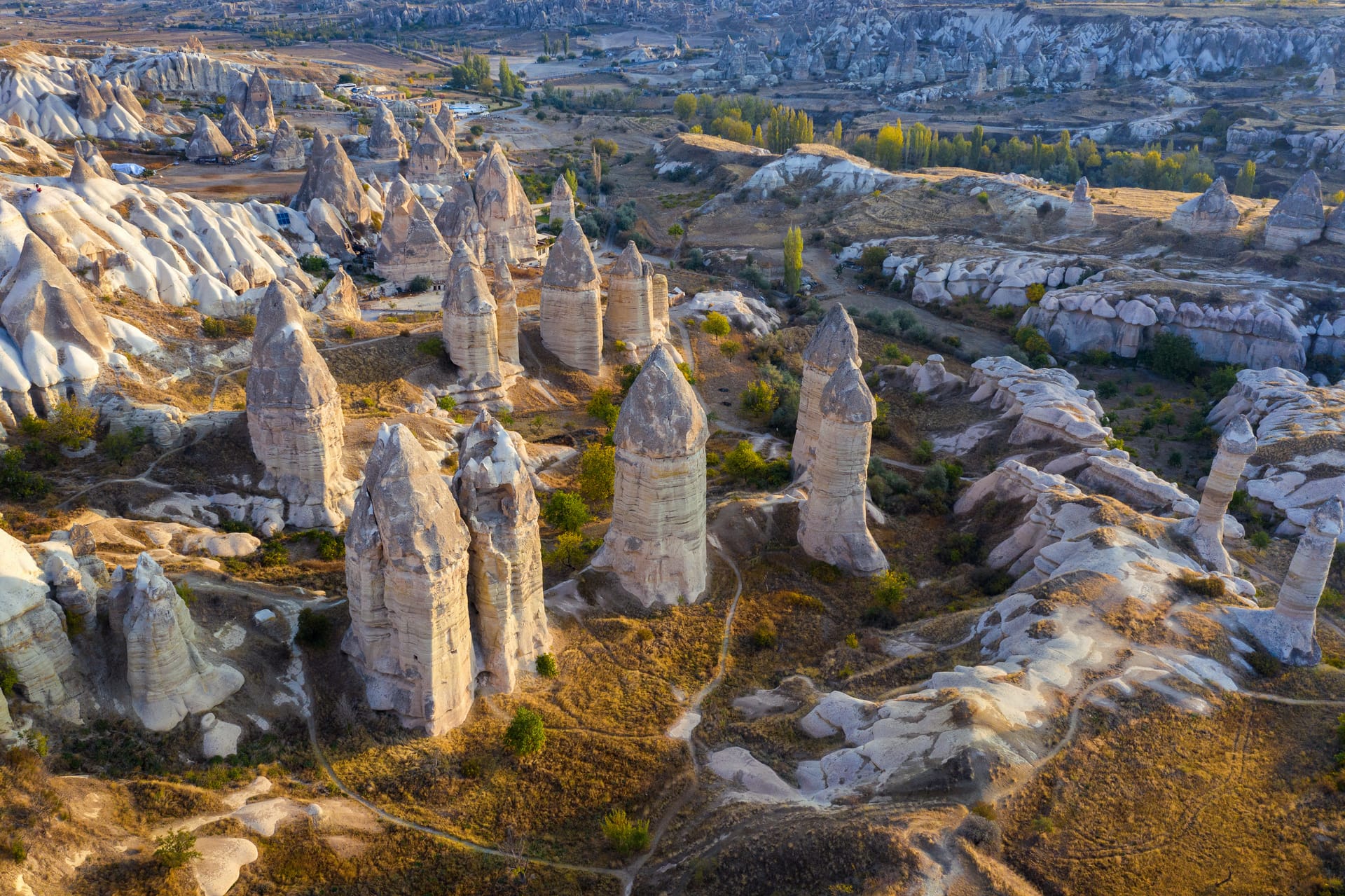
Most people discover Cappadocia at dawn — balloons drifting through pink clouds, everything dipped in golden light. But we have the privilege of being there when darkness falls too. And we can say this with confidence: Cappadocia at night is another story altogether — one that deserves to be told just as much.
In this geography where light pollution is minimal, the Milky Way is visible to the naked eye on a clear night. The silent silhouettes of fairy chimneys stand directly beneath the sky — as if these rock formations have been standing for thousands of years as companions to the stars. This is one of those rare intersections between astrophotography and portrait photography.
Why Is Cappadocia Night Photography So Special?
Many destinations can be compelling for night photography. But several factors make Cappadocia genuinely unique in this regard:
Light Pollution Map
Located far from Turkey's major cities on the central Anatolian plateau, Cappadocia falls within Bortle class 2–3. That means a cleaner sky than most major city observatories. The shadow of Venus, meteor trails, the Andromeda Galaxy visible without optical aid — these are ordinary moments here.
The Uniqueness of the Terrain
Very few places on Earth combine spectacular sky conditions with such dramatic landforms. Fairy chimneys, ranging from 5 to 40 meters in height, reach toward the sky — and when silhouetted beneath the Milky Way, the composition needs nothing added.
The Darkness of the Valleys
Locations like Göreme, Red Valley, and Love Valley are virtually deserted at night. Some valley interiors are even shielded from surrounding village lights. This creates ideal conditions for long-exposure work.
Best Night Photography Locations
Red Valley Ridge
A natural outcropping at the top of the valley provides a south-facing, open-horizon viewpoint. The Milky Way passes almost vertically across this spot from left to right. In long exposures (20–30 seconds), the texture of the rock and star trails meet in the same frame.
Pigeon Valley Interior
One of the least-explored night locations in the region. Viewed from inside the valley, rock formations frame the composition with a natural tunnel effect — the sky narrows but gains focus. The silhouette of Uchisar can also enter this frame in the background.
Love Valley Entrance
A few tall stone columns stand within walking distance of the entrance. With these columns in the foreground and the Milky Way behind them, a classic Cappadocia night photograph is within reach. Particularly during new moon periods — weather permitting — nothing else needs to be added to this frame.
Near Çavuşin Village
One of the points with the least light pollution in all of Cappadocia. The abandoned cave houses nearby add a historic depth to the image. Long exposure allows these structures to anchor the foreground while the Milky Way fills the sky above.
Technical Guide: Night Photography Fundamentals
Equipment
The limiting factor in night photography is always light. There are three ways to compensate: wide aperture (f/1.4–f/2.8), high ISO (1600–6400, depending on the sensor), and long exposure (15–30 seconds for star points; longer creates trails).
Focusing in the Dark
Autofocus does not work in darkness. You need to find the infinity focus point manually. Our method: in live view, zoom in 10x on a distant star or light point, focus manually, then lock it. Skipping this step can mean the entire night's work comes back blurred.
White Balance
Auto white balance makes night scenes look orange and artificial. Manual Kelvin settings (3200–4000K) preserve the natural yellow-blue gradient of the Milky Way. If you're shooting RAW, this can be corrected in post; if JPEG, set it from the start.
Composition
In night photography, a sky without a foreground reference point is not sufficient on its own. Fairy chimneys, stone columns, a small silhouetted figure — these give the scene meaning. The rule: let at least one-third of the frame be occupied by the earth.
Moon Calendar and Seasonal Preferences
Best Period: New Moon Weeks, April through October
The Milky Way is observable in Cappadocia from late March through early October. The moon phase is the most critical variable: during full moon week, the Milky Way is practically invisible. The 3–4 days around the new moon are the golden window.
Winter Night Sessions
The Milky Way is absent from November through February. But winter nights have their own beauty: star cluster density increases, the atmosphere is calmer. If snow has fallen, the silhouette of fairy chimneys against a white ground becomes something else entirely under night skies.
Combining Portraits with Night Photography
Astrophotography is a discipline in its own right. But here, we photograph not only the sky — we photograph the people beneath it. Combining the two is technically demanding but absolutely achievable.
Light Painting
Illuminating a figure or rock formation with a handheld light or soft LED during a long exposure is the most practical way to render both the subject and the background stars sharp in the same frame. The result looks like an illuminated stage — something between the real and the mythic.
Two-Frame Compositing
An exposure optimized for the sky may not be correct for the ground. Two separate exposures — one for the sky, one for the ground and figure — can be combined in post-processing to achieve both subject detail and star sharpness. This approach does not compromise authenticity; done well, it provides a depth that no single exposure can match.
Practical Preparation for Night Shoots
- Warm layers are essential — Cappadocia nights are cool even in summer, and cold in spring and autumn.
- Bring a red-light torch — it preserves your night vision without disturbing your eyes' dark adaptation.
- Charged batteries and a spare — cold temperatures drain battery life rapidly.
- A sturdy tripod — in long exposures, the smallest vibration ruins the frame.
- Share your location — in some valleys, letting someone know where you are is strongly recommended.
For 8 years we've been crafting stories in Cappadocia's light — and its dark. 50,000+ frames, hundreds of happy clients. We're ready to write your story too. View Portfolio | Get in Touch
For a complete overview, see our Behind the Lens: Cappadocia Photography.
Your story begins in Cappadocia
We'll craft something timeless — quiet, elegant, and cinematic.
Explore Experiences