
What to Wear for a Cappadocia Photoshoot: The Complete Outfit Guide
Seasonal color palettes, fabric choices, layering strategies, and couples coordination — everything you need to make your Cappadocia shoot visually unforgettable.
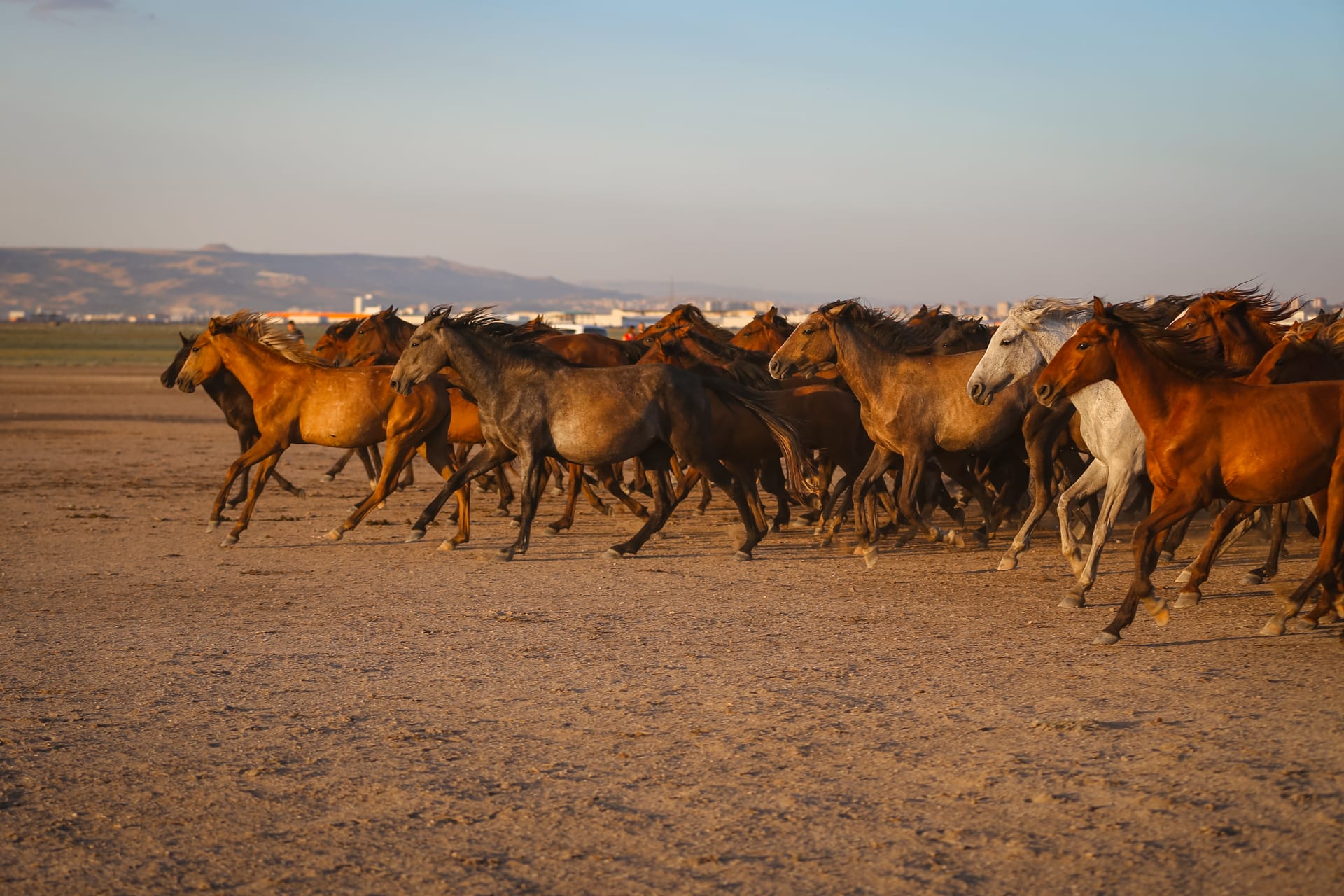
As sunrise breaks over Cappadocia, the sky moves through deep violet, then a startling rose, then pure gold. The entire landscape is bathed in light that shifts every ninety seconds. Your outfit doesn't just dress you — it becomes part of that scene. The color you wear, the way the fabric moves in the morning wind, whether your silhouette softens or sharpens against the valley walls — all of this shapes the photographs you'll keep for the rest of your life.
This guide covers everything: seasonal color palettes, the best fabrics for Cappadocia's conditions, layering strategies for cold dawn starts, footwear that actually works, accessories that add rather than distract, and how to coordinate with your partner without looking like you're in matching uniforms. Browse our experience collection and you'll notice each shoot has a distinct visual mood — we can help you dress for exactly that.
Seasonal Color Guide
Cappadocia offers a different canvas in every season. Matching your palette to the landscape creates photographs with natural depth and visual harmony that editing alone can never achieve.
Spring (April – May): Wildflowers and Soft Pastels
Spring in Cappadocia is a quiet explosion — the valleys fill with pale yellow grasses and sporadic wildflowers, and the light carries a gentle softness that flatters almost every palette. Dusty lavender, pale white, peach, sage green, and soft sky blue all work beautifully. Earth-toned bases with floral accessories echo the season without trying too hard. Avoid heavily saturated colors — they read as discordant against the soft spring backdrop.
Summer (June – August): Rich Earth and Sharp Contrast
By summer the land is dry and golden, and the light is hard-edged and bright. This is when warm, saturated tones come alive: terracotta, burnt copper, amber, deep rust, and warm white. White itself remains a timeless choice in summer — it contrasts beautifully with the tawny stone. Choose breathable natural fabrics to stay comfortable through the warmth of even an early-morning session.
Autumn (September – November): Golden Light at Its Deepest
Autumn is a photographer's favorite season in Cappadocia. The sun stays low all day, producing golden-hour quality light from morning to evening. The landscape deepens into ochre and rust, and the light turns amber. Jewel tones work magnificently here: ruby red, burgundy, deep mustard, olive green, antique gold. Textured fabrics — knit, velvet, structured wool — add visual weight and complement the season's palette.
Winter (December – March): Snow, Mist, and Drama
A snow-dusted Cappadocia is a rare and extraordinary shoot environment. White and cream create a tonal depth against the snow that no other season offers. Alternatively, deep navy, charcoal, or rich burgundy create dramatic contrast — you become a vivid brushstroke against a monochrome world. Layering in winter isn't just aesthetic advice; it's essential. Thin thermal layers under your main outfit keep you comfortable through shoots that begin before the sun has warmed the air.
The Best Fabrics for Cappadocia
Wind is a constant companion in Cappadocia — along valley edges, at high viewpoints, and open plains, it is rarely still. This is actually an advantage: the right fabric responds to that wind and introduces cinematic movement into your frames.
Fabrics Photographers Love
- Chiffon and tulle: Weightless, semi-transparent, and spectacular in motion. A chiffon skirt at a valley edge with balloons behind you creates images that look like film stills from a fairy tale.
- Silk and satin: Absorbs and reflects light simultaneously. In golden hour, a satin blouse becomes its own light source, warming your skin in every frame.
- Linen: Natural, relaxed, and tonally complementary to Cappadocia's stone textures. A pale linen shirt or wide-leg linen trousers in summer reads as effortlessly elegant.
- Velvet and knit: Perfect for autumn and winter. They add texture and dimensional richness that photographs with extraordinary depth.
Fabrics to Avoid
- Synthetic nylon and polyester — they reflect harshly under direct sunlight and photograph with an unnatural sheen.
- Overly structured, stiff fabrics — stillness in fabric reads as stiffness in the person wearing it.
- Heavy graphic prints and large patterns — they draw the eye away from your face and disconnect you visually from the landscape.
Layering for Sunrise Shoots
Sunrise sessions begin between 05:00 and 06:30 AM. Even in July, that hour can be cool; in winter, it is genuinely cold — valley floors can dip below freezing in December. Layering correctly means you stay warm between shots and look polished in every frame.
A Practical Layering Strategy
Start with a thin thermal base — invisible under your outfit but essential for the walk from the car to the location. Over that, your main outfit: a long-sleeve dress, flowing wide-leg trousers, or a layered skirt ensemble. For the outermost layer, choose something you can remove quickly for shots — a fine cashmere or alpaca wrap is ideal, because it doubles as a prop: draped over shoulders, wrapped around the arms, held loosely at the side. A structured coat that opens completely (rather than a pullover) lets you transition in and out of it smoothly during the session.
Footwear: The Practical Approach
Reaching Cappadocia's best locations often involves 10 to 20 minutes of walking on loose gravel, uneven stone paths, or sandy valley floors. Heels are genuinely difficult — and in some places, genuinely hazardous. Our consistent recommendation is to bring two pairs.
The Two-Pair Rule
Wear your comfortable shoes for the walk to the location — flat sandals, low ankle boots, or clean trainers. Carry your chosen shoot footwear in a bag. When you reach the position and your photographer is setting up the first frame, swap. Flat-heeled sandals, elegant ballet flats, or soft leather ankle boots all photograph beautifully and remain walkable. In winter, insulated flat-soled boots are both warm and visually strong — especially against snow.
Accessories: Choose Fewer, Choose Better
In Cappadocia's landscapes, less is almost always more. The location itself is the most powerful visual element in the frame — your accessories should complement you, not compete with the scene.
- Hats: Wide-brim straw hats in spring and summer; structured wool berets in autumn and winter. Both add a visual anchor and serve a practical purpose (sun protection or warmth).
- Jewellery: Fine and minimal. A thin gold chain, small earrings, a delicate bracelet — these catch the light subtly without overpowering. Large, elaborate pieces photograph as distractions.
- Bags: Leave them with the photographer between shots. A bag rarely improves a photograph.
- Florals — bouquets and crowns: For romantic and bridal-style shoots, these are one of the most effective accessories Cappadocia allows. Our add-on services include fresh bouquet and flower crown options.
What to Avoid: A Quick Checklist
- Heavy graphic prints and large brand logos
- Neon colors — particularly lime and electric yellow
- Very short or very tight silhouettes (movement restriction and wind exposure)
- New, unworn shoes (uncomfortable feet affect your expression)
- Overly complex updos — loose waves, a relaxed braid, or a low bun survive the wind and photograph more naturally
Outfit Changes: Two Worlds in One Shoot
For longer sessions or full-day package experiences, a second outfit change transforms your shoot gallery into a proper editorial story. Moving from a cool, layered early-morning look to a lighter, more flowing afternoon look — against different light and potentially different locations — gives you two distinct visual narratives from the same day.
The most effective strategy: keep the two outfits in different color families. If the first is neutral and cool (cream, white, grey), make the second warm and saturated (terracotta, deep red, amber). The contrast between the two sets reads beautifully both on social media and in print.
Couples Coordination
Coordination does not mean matching. Two people in identical outfits photograph as a costume, not a couple. The approach that consistently works best is tonal harmony: stay within the same color family, but let each person wear their own variation.
The Tonal Harmony Rule
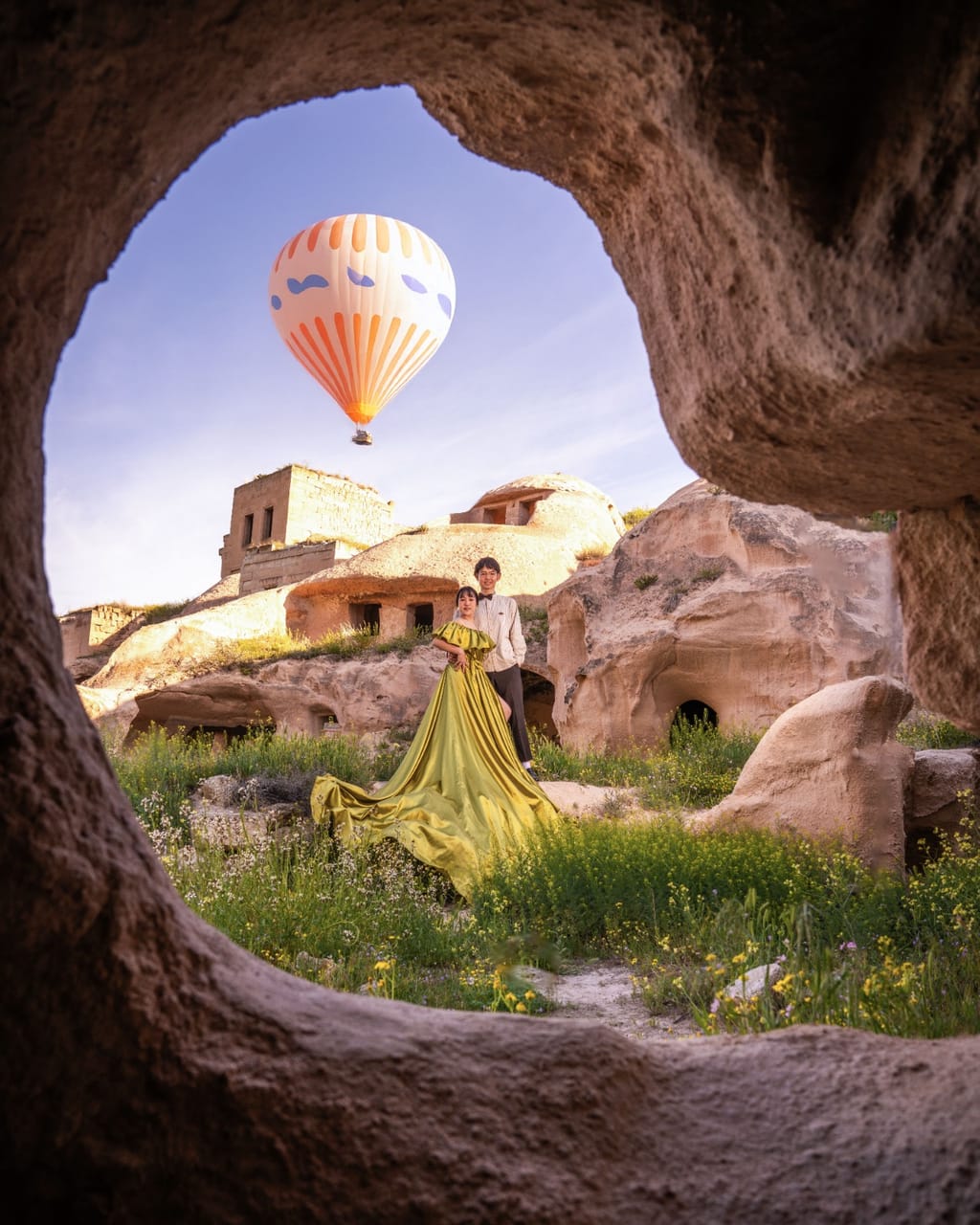
If one person wears a cream dress, the other might wear sand-colored linen trousers and a white shirt. If one wears deep burgundy, the other could wear charcoal or deep green. The palette reads as unified; the individuals read as themselves. For patterns: if one outfit carries texture or print, the other should be plain. Two patterned outfits in a frame create visual noise that draws attention away from both faces.
The Flying Dress Option
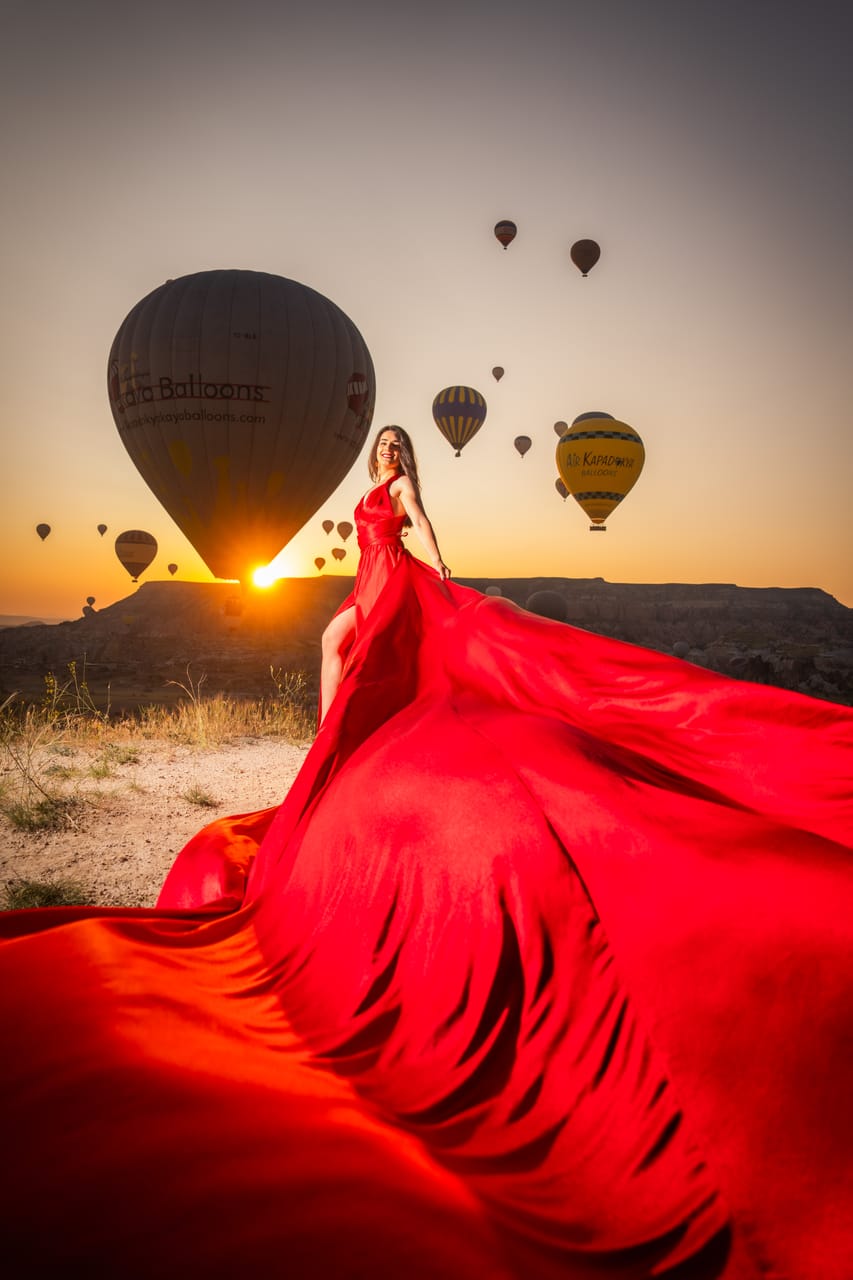
Few images are more immediately associated with Cappadocia than a long dress caught by the wind, floating impossibly above the valley floor with a fleet of balloons on the horizon. The flying dress experience takes this visual language and executes it intentionally — the right fabric, the right location, the right light, and a photographer who knows exactly how to direct the movement.
You're welcome to bring your own dress. If you do: look for a skirt with at least 2–3 metres of fabric, made from chiffon, tulle, or silk organza. Anything narrower or stiffer won't give you the dramatic lift the photographs require. Alternatively, our flying dress rental service includes a curated selection across multiple colors and silhouettes — it solves the luggage problem and gives you the flexibility to choose a color specifically suited to the light and location of your session.
For a deeper look at which colors work best by season and location, our Flying Dress Color Guide breaks it down in detail.
Hair and Makeup: Complete the Picture
The most carefully chosen outfit can be undermined by hair and makeup that don't read well outdoors. Cappadocia's wind is the primary challenge: complex, structured styles that might look immaculate in a studio will come apart within minutes of arriving at the location.
For hair, natural movement is your friend. Loose waves, a relaxed braid, or a low bun pinned loosely enough to allow a few strands to move freely — these all work beautifully on-location and age well in photographs. For makeup, matte or satin-finish products hold significantly better in bright outdoor conditions than glossy finishes, which can reflect harshly in direct light. If you'd like professional assistance, our hair and makeup add-on is handled by stylists who understand exactly what holds up from a 5 AM call time through a 3-hour shoot.
Final Pre-Shoot Checklist
- Try on your complete outfit — shoes included — and walk around for five minutes. Any discomfort will multiply on location.
- Check whether anything needs pressing or dry cleaning the night before.
- Pack a small touch-up kit: lipstick, a fine comb, a backup hair tie, a compact mirror.
- Bring thermal layers for early-morning starts, regardless of season.
- Share a photo of your outfit with your photographer on WhatsApp before the shoot — they can flag any color or fabric concerns specific to your location and light conditions.
Want to go further with your planning? Our Cappadocia Photoshoot Planning Guide covers location selection, timing, logistics, and what to expect from your session start to finish.
Frequently Asked Questions
Does black work well in Cappadocia photoshoots?
Yes — particularly in blue hour, winter, and low-light sessions. Black creates strong contrast and reads as elegant in those conditions. In bright summer sunlight, however, black can sometimes photograph as a flat dark mass rather than a rich garment. If you love black, choose matte, flowing fabrics (chiffon, silk) rather than structured polyester, and let your photographer know in advance so they can adjust their exposure approach.
How many outfits should I bring?
Two outfits is ideal for a standard session. One main look for the primary shoot, and one alternative for when the light changes or you move to a different location. For full-day experiences or package shoots, up to three outfits works well — morning, afternoon, and golden-hour evening looks give you a genuinely varied gallery.
Should my partner and I wear the same color?
Not identically. Tonal coordination — the same color family in different shades and textures — is far more photogenic than matching. One person in ivory, the other in warm beige. One in deep burgundy, the other in forest green or charcoal. The palette reads as harmonious; both individuals remain visually distinct.
Is it better to rent the flying dress or bring my own?
Either works well. If you bring your own, prioritize fabric over everything else: minimum 2–3 metres of skirt in chiffon, tulle, or organza. If you rent from us, you avoid the logistics of travelling with a large garment and gain the flexibility to choose your color based on the session's location and light. View our rental collection in advance to see what's available.
What should I wear in windy conditions?
Wind is a photographic asset, not a problem — but only with the right fabrics. Mid-weight chiffon and silk blends move expressively without becoming uncontrollable. Wide, flowing silhouettes work far better than fitted or short styles. For hair, a loose braid or low bun is the most practical choice. Brief your photographer on your outfit before you arrive — they'll plan positions that use the wind direction to your advantage.
Ready to begin your Cappadocia story? Share your dates and style — we'll plan the location, timing, and outfit coordination together. Start Planning or message us on WhatsApp.
Your story begins in Cappadocia
We'll craft something timeless — quiet, elegant, and cinematic.
Explore Experiences